Showing posts with label electrical laws. Show all posts
Define Kirchhoff's circuit laws:
Kirchhoff's circuit laws are two equalities that deal with the current and potential difference (commonly known as voltage) in the lumped element model of electrical circuits. They were first described in 1845 by German physicist Gustav Kirchhoff. This generalized the work of Georg Ohm and preceded the work of Maxwell. Widely used in electrical engineering, they are also called Kirchhoff's rules.
Kirchhoff's current law (KCL):
or equivalently
- The algebraic sum of currents in a network of conductors meeting at a point is zero.

Kirchhoff's voltage law (KVL)
- The directed sum of the electrical potential differences (voltage) around any closed network is zero, or:
- More simply, the sum of the emfs in any closed loop is equivalent to the sum of the potential drops in that loop, or:
- The algebraic sum of the products of the resistances of the conductors and the currents in them in a closed loop is equal to the total emf available in that loop.
- More simply, the sum of the emfs in any closed loop is equivalent to the sum of the potential drops in that loop, or:


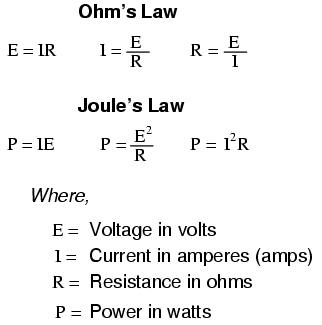
Ohm's Law
Define:- Ohm's law states that the current through a conductor between two points is directly proportional to the potential difference across the two points. Introducing the constant of proportionality, the resistance, one arrives at the usual mathematical equation that describes this relationship

Joule's laws
Define:- Joule's laws are two laws about heat produced by an electric current and the energy dependence of a gas to pressure, volume and temperature.
Joule's first law shows the relation between heat generated by an electric current flowing through a conductor. It is named after James Prescott Joule and shown as: